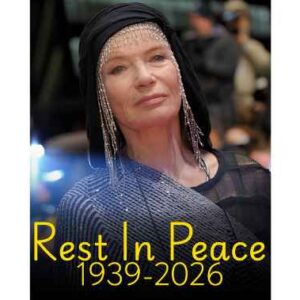
The fashion world has lost one of its most extraordinary and influential figures.
Vera von Lehndorff, internationally known as Veruschka, the legendary German model, actress, and visual artist who helped define the modern supermodel, died at her home in Berlin on November 24, 2026. She was 87.
Her death was confirmed through an announcement published on the website of the fashion brand owned by her sister, Catharina Kappelhoff-Wulff. According to reports, she was surrounded by loved ones during her final moments. No cause of death has been publicly disclosed. (Source: People)
Behind the unforgettable face that appeared on magazine covers around the world was a woman whose life had been shaped by unimaginable childhood tragedy, displacement, artistic ambition, and an extraordinary determination to reinvent herself.
Her journey from a German aristocratic family devastated by World War II to international fashion royalty remains one of the most remarkable stories in modeling history.
A Childhood Shattered by World War II
Born on May 14, 1939, in Königsberg, East Prussia, now Kaliningrad, Russia, Vera Gottliebe Anna von Lehndorff-Steinort belonged to a distinguished German aristocratic family.
Her father, Count Heinrich von Lehndorff-Steinort, and her mother, Countess Gottliebe von Lehndorff, raised their children at the family’s historic Steinort estate.
However, the privileges associated with her aristocratic background could not protect her from the devastation of war.
When Vera was just five years old, her father was executed by the Nazi regime for his participation in the German resistance and his involvement in the failed July 20, 1944, plot against Adolf Hitler.
The execution destroyed the family’s former way of life.
A rare childhood photograph of Vera von Lehndorff with her father, Count Heinrich von Lehndorff, before his death in 1944.
Source: Berlin-Brandenburg Academy of Sciences and Humanities — Lehndorff Family Archive
The Nazi authorities retaliated against the family, taking Vera and her relatives into custody. Her mother and children endured forced separation, detention, and the uncertainty of surviving a collapsing regime.
Although the family eventually reunited, the security of their earlier lives was gone. They faced the difficulties of displacement and rebuilding their lives in postwar Germany.
For Vera, these experiences belonged to a world far removed from the glamorous photographs that would later make her famous.
Before she became an international symbol of beauty, she was a little girl growing up in the aftermath of profound loss.
Countess Gottliebe von Lehndorff with her four daughters, including Vera, in 1949. Vera was approximately ten years old.
Source: Berlin-Brandenburg Academy of Sciences and Humanities — Lehndorff Family Archive
From Art Student to International Fashion Icon
As a young woman, Vera developed an interest in art, pursuing her studies in Hamburg and Florence.
In 1959, at approximately 20 years old, she was discovered by Italian photographer Ugo Mulas.
Standing around six feet tall, with an unusually slender figure and distinctive facial features, Vera possessed an appearance that challenged many conventional expectations of beauty at the time.
Yet international success did not arrive immediately.
Her first attempts to establish herself in New York proved disappointing. She returned to Europe, where she continued developing her skills in front of the camera, including through collaborations with Italian photographer Johnny Moncada.
Rather than abandoning her ambitions, she reconsidered how she presented herself to the fashion industry.
She adopted the name Veruschka, a Russian diminutive of Vera, and developed an enigmatic professional identity that distinguished her from other aspiring models.
When she returned to New York in 1964, the fashion industry was becoming increasingly receptive to unconventional beauty and individual expression.
Her transformation was not simply a change of name. It was an act of creative self-invention that would help establish her as an international star.
The Woman Who Helped Define the Supermodel
During the 1960s, Veruschka became a favorite of influential American Vogue editor-in-chief Diana Vreeland.
Vreeland recognized that fashion photography could offer more than attractive clothing. It could create imaginary worlds, express cultural change, and transform models into recognizable personalities.
Veruschka was exceptionally suited to that vision.
She appeared on 13 covers of American Vogue, according to the magazine’s own obituary, and worked with some of the most influential photographers of the twentieth century.
Among them were Richard Avedon, Irving Penn, Horst P. Horst, Helmut Newton, David Bailey, and Franco Rubartelli.
Her collaborations with Rubartelli, who was also her romantic partner, produced some of the most imaginative fashion photographs of the era.
Veruschka photographed by Franco Rubartelli for Vogue, April 1967.
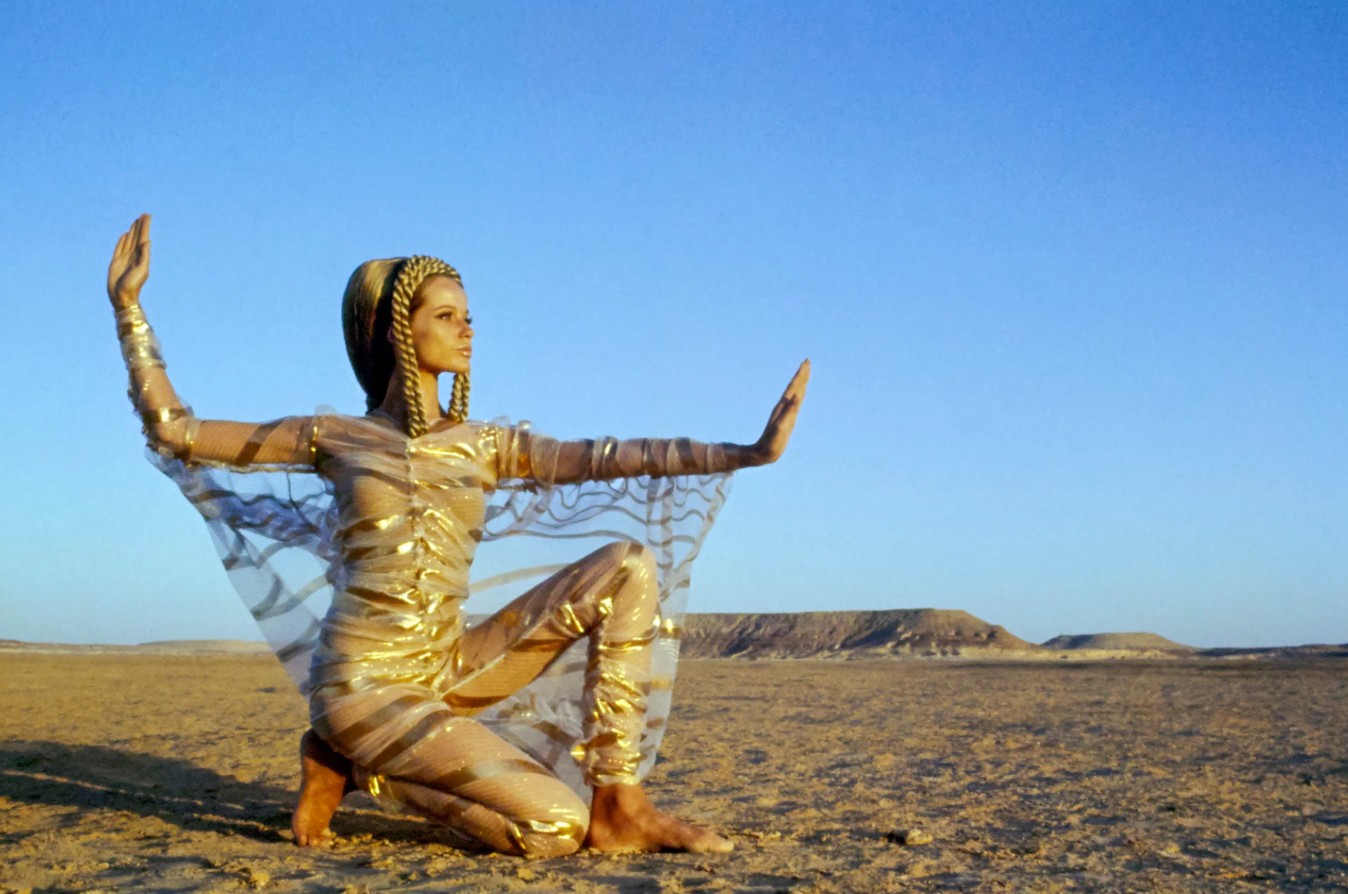
Source: American Vogue — Franco Rubartelli
What distinguished Veruschka from many of her contemporaries was her willingness to experiment with movement, posture, expression, and character.
She could communicate strength, vulnerability, elegance, or mystery without speaking a word.
Her photographs demonstrated that a fashion model could participate actively in creating an artistic composition rather than merely displaying a designer’s garments.
Alongside other celebrated figures of the decade, including Twiggy and Jean Shrimpton, Veruschka helped establish the cultural phenomenon that would eventually become known as the supermodel.
The Legendary Great Fur Caravan
One of Veruschka’s most ambitious collaborations with photographer Richard Avedon took place in Japan in 1966.
The project, titled The Great Fur Caravan, appeared in the October 15, 1966, issue of Vogue.
The production brought together dramatic winter landscapes, elaborate garments, international travel, and an ambitious approach to visual storytelling.
Instead of relying on conventional studio settings, Avedon and his team used Japan’s mountainous and snow-covered surroundings to create a fashion editorial on an extraordinary scale.
Veruschka’s theatrical abilities allowed her to inhabit the imaginative characters that the production demanded.
An original spread from The Great Fur Caravan, photographed by Richard Avedon and published in Vogue on October 15, 1966.
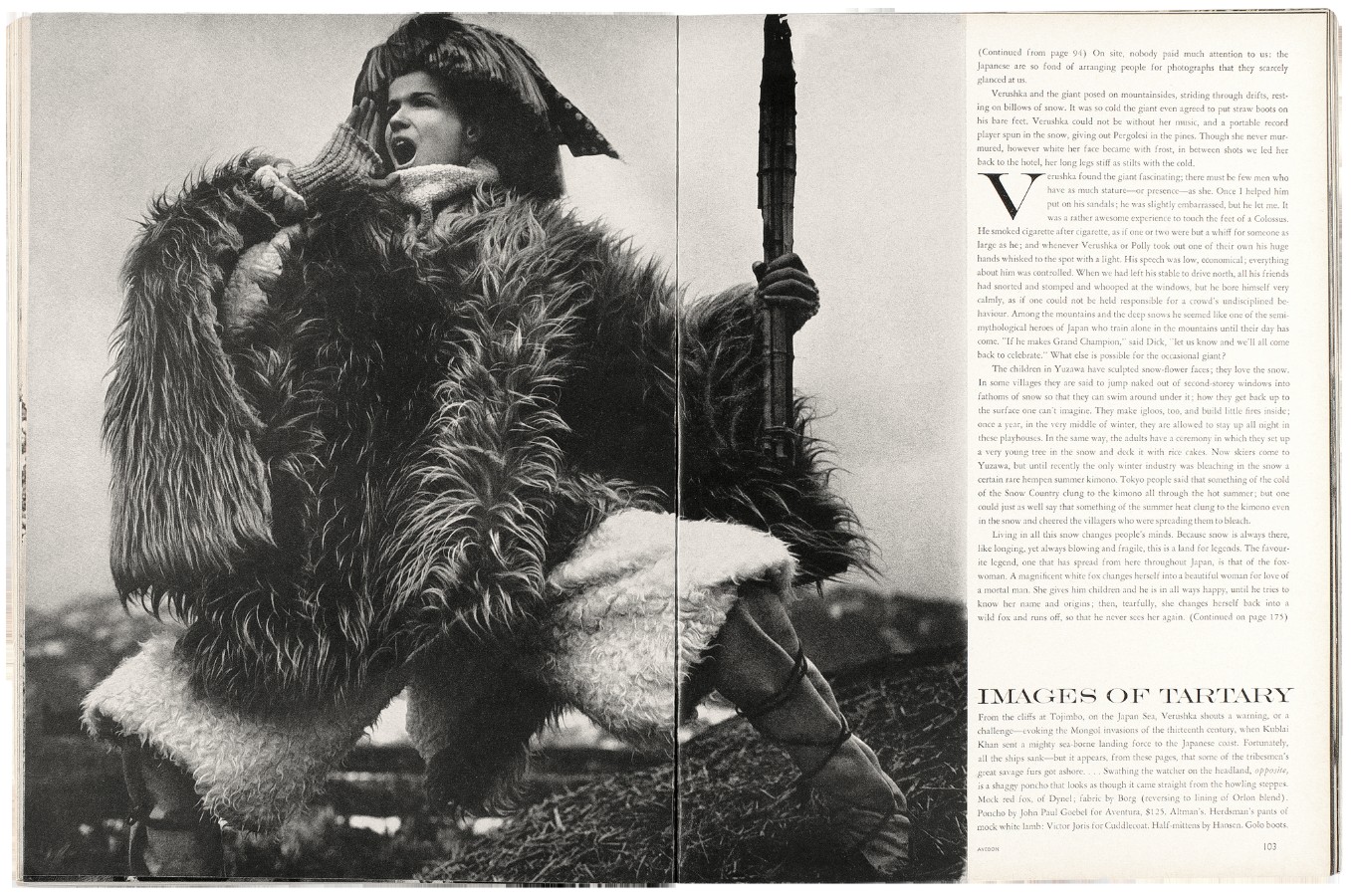
Source: The Richard Avedon Foundation — Vogue Archive
The elaborate editorial became an enduring example of the creative ambitions of 1960s fashion publishing.
Her partnership with Avedon continued beyond that project. In March 1967, Vogue published another extensive editorial featuring Veruschka, further demonstrating her expressive range and their shared artistic imagination.
Becoming a Cinematic Icon in Blow-Up
Veruschka’s fame extended beyond fashion magazines when she appeared in Michelangelo Antonioni’s groundbreaking 1966 film Blow-Up.
Set against the backdrop of London’s fashionable creative scene, the film explores the complicated relationship between photography, reality, perception, and human behavior.
Veruschka appeared as herself opposite British actor David Hemmings, who portrayed a fashion photographer.
Although her appearance was relatively brief, it became one of the film’s most recognizable sequences.
Her performance captured the intensity and theatricality associated with fashion photography during the Swinging Sixties.
Veruschka and David Hemmings in Michelangelo Antonioni’s Blow-Up, released in 1966.
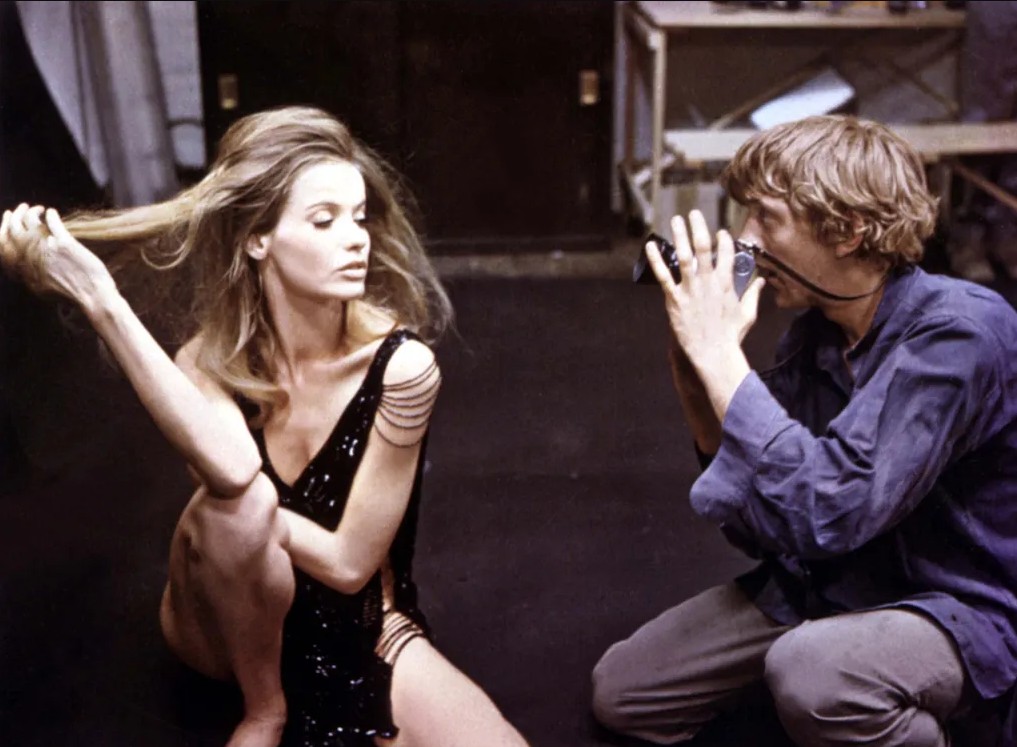
Source: American Vogue — Veruschka’s Career Retrospective
The film introduced her to audiences who might never have encountered her work in fashion magazines.
In August 1967, her growing international fame earned her a cover of LIFE magazine, further establishing her status as a cultural celebrity.
Veruschka had become more than a successful model. She was an unmistakable presence in the visual culture of an entire generation.
Decades later, she returned to the big screen with a small appearance as a poker player in the 2006 James Bond film Casino Royale, starring Daniel Craig.
Walking Away From Conventional Fashion
Despite her considerable success, Veruschka never appeared entirely comfortable with being valued solely for her physical appearance.
During the 1970s, she increasingly distanced herself from mainstream fashion and devoted more attention to independent artistic projects.
She began collaborating with German artist and photographer Holger Trülzsch, developing experimental works that combined photography, performance, and body painting.
Through carefully painted surfaces and elaborate visual compositions, she transformed her body into a medium of artistic expression.
In some works, the human figure appeared to merge with natural surroundings or architectural surfaces. In others, it assumed unfamiliar identities and forms.
These experiments challenged traditional ideas about beauty, visibility, and the relationship between the human body and its environment.
For a woman whose international fame had depended on being recognizable, the artistic decision to conceal or transform her appearance represented a particularly fascinating departure.
Her contributions helped establish an important connection between fashion photography, performance art, and contemporary visual culture.
Returning to Fashion on Her Own Terms
Although Veruschka moved away from the conventional modeling industry, she never completely abandoned it.
In 1994, she returned to the runway for Chanel under the creative direction of Karl Lagerfeld.
In September 2010, at the age of 71, she appeared in British designer Giles Deacon’s Spring 2011 fashion show in London.
These appearances demonstrated that her influence had survived long after the decade that first made her famous.
Then, in 2017, she returned to fashion photography in a particularly memorable way.
At 78 years old, Veruschka was selected to model Acne Studios’ Resort 2018 collection.
The campaign placed a woman whose career had begun in the 1950s at the center of a contemporary fashion collection, challenging the industry’s persistent association between youth and desirability.
Veruschka at age 78, modeling for the Acne Studios Resort 2018 collection, photographed and published in 2017.
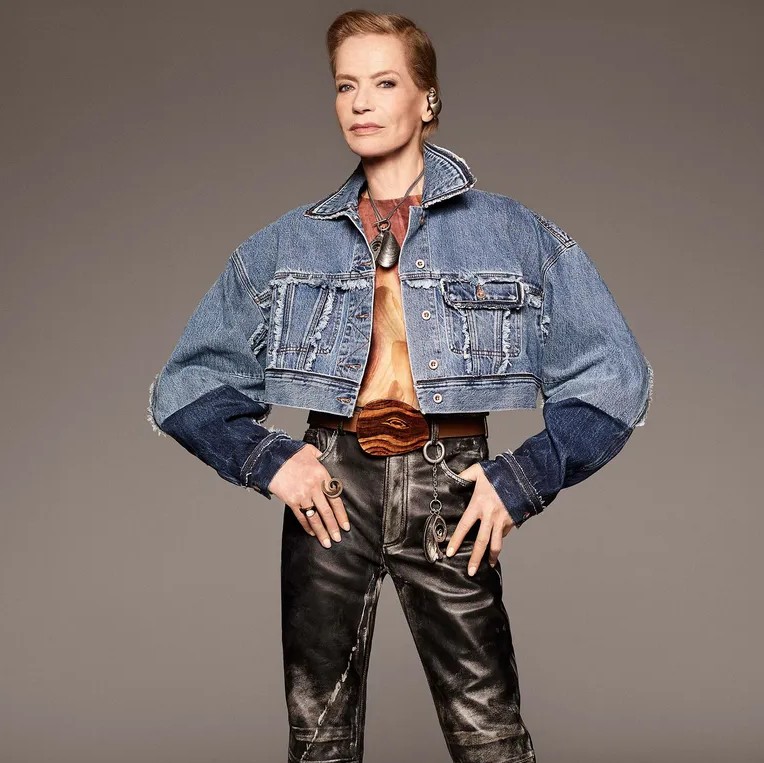
Source: American Vogue — Courtesy of Acne Studios
Her return was significant not because she attempted to recreate her youthful appearance, but because she demonstrated that creative energy, individuality, and presence could remain compelling throughout a lifetime.
Her Final Years and the Continuing Influence of Her Art
Veruschka spent her later years in Berlin, maintaining a considerably more private life than the international celebrity lifestyle associated with her earlier career.
According to Page Six, her last documented public appearance took place in September 2017, when she attended the opening of Louis Vuitton’s Time Capsule exhibition in Berlin.
Her withdrawal from frequent public appearances did not diminish interest in her work.
In 2026, the East Prussian State Museum in Lüneburg, Germany, presented an exhibition titled The Seen and the Unseen: Holger Trülzsch & Vera Lehndorff (Veruschka).
Running from April 25 through October 18, the exhibition explored the experimental body-painting photographs that the two artists had created during the 1970s and 1980s.
It served as a timely recognition of Veruschka’s artistic achievements beyond the fashion industry, closing just weeks before her death.
(Source: East Prussian State Museum)
Following news of her passing in November 2026, fashion publications and members of the international creative community reflected on her extraordinary contributions.
Their tributes recognized not only the woman who appeared on magazine covers, but also the artist who consistently challenged expectations and explored new forms of expression.
A Legacy That Transcends Beauty
The life of Vera von Lehndorff cannot be measured solely by magazine covers, designer collections, or photographs.
She survived a childhood marked by war and the execution of her father. She rebuilt her life in a changing world, overcame professional setbacks, and established a career that helped transform the international fashion industry.
At the height of her fame, she chose to pursue creative interests that extended far beyond the expectations placed upon her.
She challenged traditional modeling conventions, explored the boundaries of performance art, and demonstrated that growing older did not mean surrendering one’s individuality.
Her influence can still be recognized in contemporary fashion campaigns, conceptual portraiture, experimental photography, and the idea that models can be artists and creative collaborators in their own right.
The world first came to know her as Veruschka.
But behind that legendary name was Vera von Lehndorff — a woman who refused to let a devastating past, professional expectations, or the passage of time define the limits of her life.
She leaves behind more than a collection of extraordinary photographs. She leaves a legacy of artistic freedom, reinvention, and individuality that will continue to inspire generations.
Rest in peace, Veruschka.
May 14, 1939 – November 24, 2026.