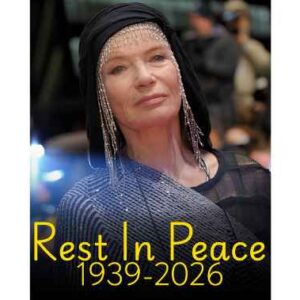
The fashion world has lost one of its most extraordinary and influential figures.
Vera von Lehndorff, internationally celebrated under the name Veruschka, died at her home in Berlin on November 24, 2026, at the age of 87. Her death was confirmed through a statement published on the website of her sister Catharina Kappelhoff-Wulff’s fashion company. She reportedly spent her final moments surrounded by family and friends.
Long before supermodels became household names, Veruschka helped establish the idea that a fashion model could become an international celebrity, an artistic collaborator, and a cultural icon.
Yet behind her unforgettable photographs and remarkable career was a woman whose childhood had been devastated by war, whose father had been executed by the Nazis, and whose journey toward international fame required her to reinvent herself.
(Source: People)
A Childhood Destroyed by World War II
Born on May 14, 1939, in East Prussia, Vera Gottliebe Anna Gräfin von Lehndorff-Steinort belonged to an established German aristocratic family.
She spent her earliest years at Steinort Castle, the ancestral home of the Lehndorff family, located in what is now Poland.
Her father, Count Heinrich von Lehndorff-Steinort, became involved in the German resistance against Adolf Hitler. His participation in the failed July 20, 1944, assassination conspiracy would have devastating consequences for his entire family.
He was subsequently executed by the Nazi regime.
Vera was only five years old.
Her pregnant mother was imprisoned, while Vera and her sisters were separated from her and placed in a Nazi-controlled children’s institution in Bad Sachsa.
The family was also stripped of its ancestral property. The privileged existence into which Vera had been born disappeared almost overnight.
Although the surviving family members were reunited after the war, they faced years of displacement and uncertainty.
(Source: WELT)
Vera von Lehndorff during her childhood with her mother and sisters, 1949.
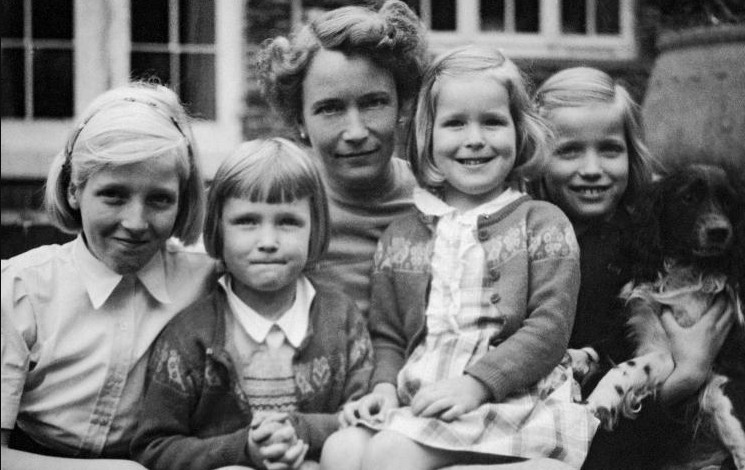
Source: Copernico – The Four Lehndorff Daughters
From a Young Art Student to an International Model
As a young woman, Vera pursued an education in art, eventually traveling to Florence, Italy, where her life took an unexpected turn.
In 1959, at approximately 20 years old, she attracted the attention of Italian photographer Ugo Mulas.
Standing more than six feet tall, Vera possessed a striking appearance that challenged conventional expectations of feminine beauty at the time.
However, international success did not come immediately.
Her early attempts to establish a modeling career in New York were disappointing. In Italy, she found greater creative opportunities, particularly through her collaboration with photographer Johnny Moncada.
Moncada photographed her extensively during the early 1960s. Thousands of photographs from this period remained largely unseen for decades before becoming the subject of a book and a 2014 exhibition at Somerset House in London.
These early collaborations marked the beginning of her transformation from an inexperienced young model into an artist capable of expressing emotion and character through photography.
(Source: ANSA)
A young Vera von Lehndorff photographed by Johnny Moncada during the early 1960s.
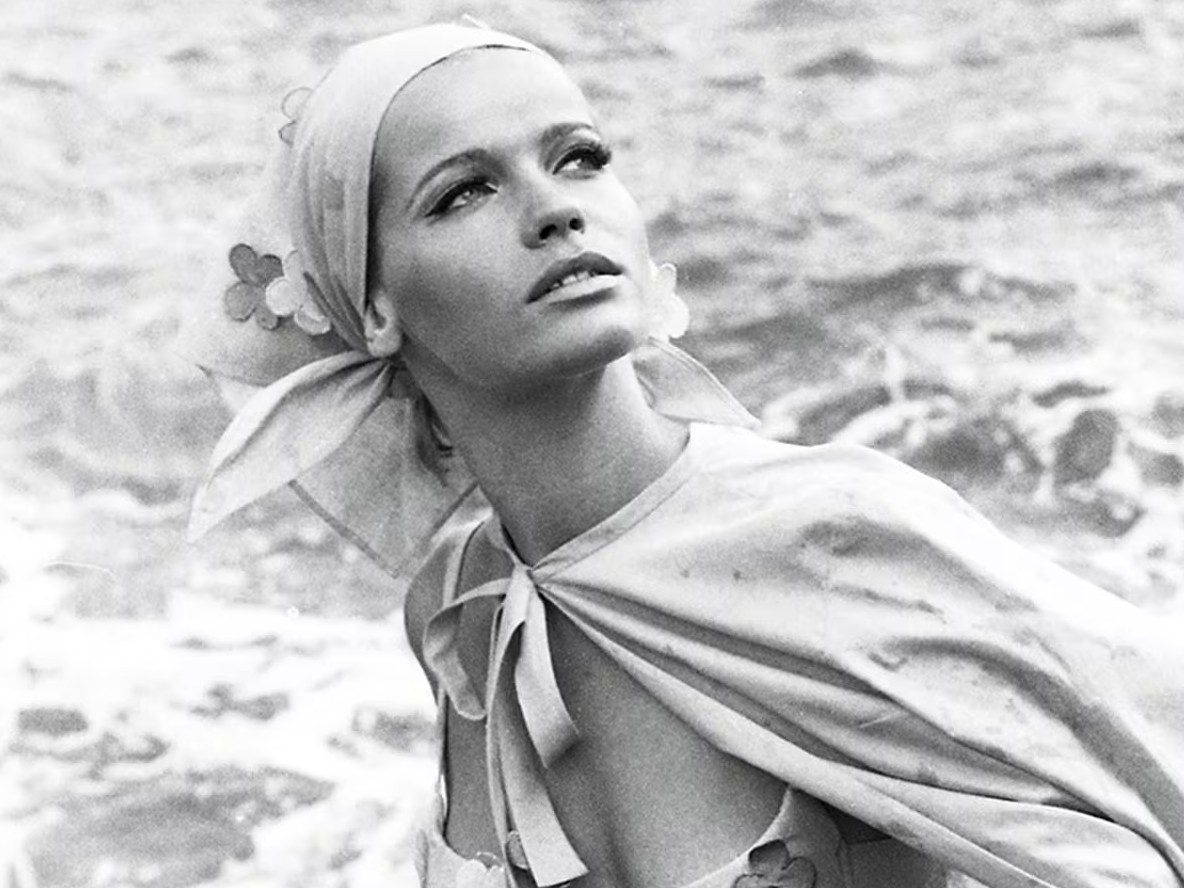
Source: The Daily Beast – The Unseen Photographs of Veruschka
The Birth of Veruschka
One of Vera’s most important career decisions was to adopt a new professional identity.
Rather than allowing her aristocratic background or difficult childhood to define her, she began presenting herself as Veruschka.
The Russian-sounding variation of her first name helped create an atmosphere of mystery around her identity. She developed an image that was unusual, sophisticated, and difficult to categorize.
When she returned to New York in 1964, the fashion industry was becoming more receptive to unconventional beauty.
She soon attracted the attention of Diana Vreeland, the legendary editor-in-chief of American Vogue.
Vreeland recognized that Veruschka possessed something beyond physical beauty: the ability to turn fashion photography into a form of storytelling.
Over the following years, Veruschka appeared on 13 covers of American Vogue, becoming one of the most recognizable and highly sought-after models of her generation.
She collaborated with celebrated photographers including Richard Avedon, Irving Penn, Horst P. Horst, David Bailey, Helmut Newton, and Franco Rubartelli.
Her success helped establish the cultural phenomenon that would later become known as the supermodel era.
(Source: British Vogue)
The Woman Who Transformed Fashion Photography
Veruschka’s influence extended far beyond the clothing she wore.
At a time when fashion models were frequently expected to display garments through controlled and conventional poses, she introduced a more expressive physical language.
Her movements could be dramatic, theatrical, elegant, or deliberately unconventional.
She treated photography as a creative collaboration rather than simply an assignment.
One of the most celebrated examples of this approach was The Great Fur Caravan, an ambitious fashion editorial photographed by Richard Avedon in Japan.
Published in Vogue on October 15, 1966, the project took the fashion team into extraordinary winter landscapes. The resulting 26-page editorial became renowned for its ambitious production and was widely regarded as one of the most expensive fashion shoots of its era.
The photographs combined luxury fashion, dramatic landscapes, theatrical performance, and visual storytelling on an unprecedented scale for the magazine.
(Source: Vogue – Polly Mellen’s Legacy)
Veruschka in Richard Avedon’s legendary fashion editorial The Great Fur Caravan, Japan, 1966.
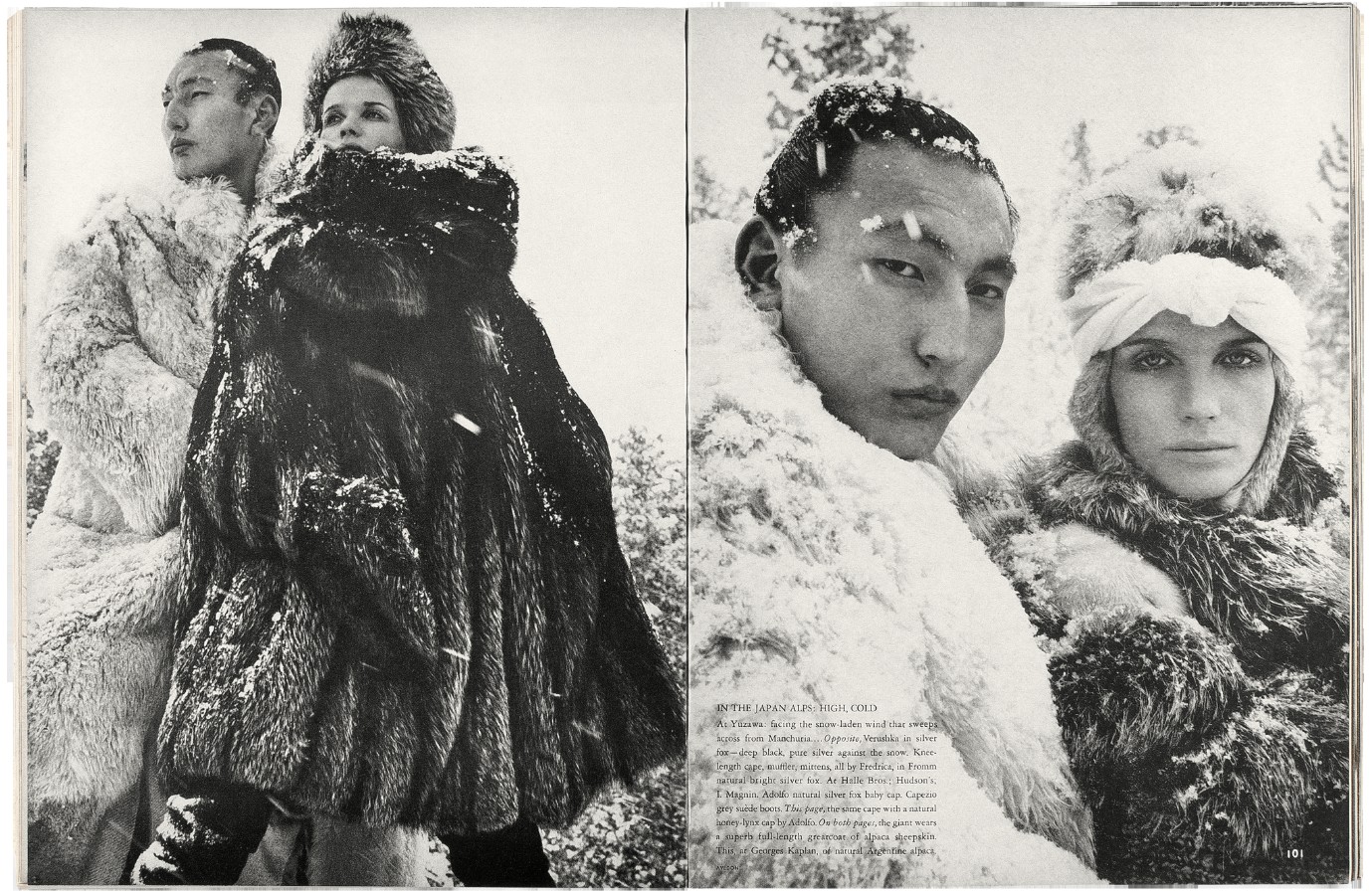
Source: The Richard Avedon Foundation – Vogue, October 15, 1966
Her creative partnership with Italian photographer Franco Rubartelli was equally significant.
Together, they produced images that challenged the distinction between fashion, portraiture, and fine art.
Veruschka was not simply the subject of these photographs. Her imagination, physical expression, and willingness to experiment contributed to their artistic identity.
Her work demonstrated that models could help shape the creative direction of an image rather than merely appear in front of the camera.
Becoming a Cinematic Icon
In 1966, Veruschka introduced herself to an even wider international audience through Michelangelo Antonioni’s influential film Blow-Up.
Set against the cultural revolution of 1960s London, the movie explored photography, perception, fame, and the uncertainties surrounding reality.
Veruschka appeared as herself opposite British actor David Hemmings, who portrayed a fashion photographer.
Although her appearance was brief, it became one of the film’s most memorable sequences.
The following year, she appeared on the cover of LIFE magazine, further demonstrating how her popularity had extended beyond the traditional fashion audience.
She would later return to cinema in several projects, including The Bride in 1985 and the 2006 James Bond film Casino Royale.
In Casino Royale, she portrayed Countess von Wallenstein, one of the participants in the high-stakes poker game involving Daniel Craig’s James Bond.
(Source: S Moda – El País)
Veruschka and David Hemmings in Michelangelo Antonioni’s Blow-Up, 1966.
Walking Away From Conventional Beauty
By the mid-1970s, Veruschka was increasingly dissatisfied with the restrictions of commercial modeling.
Instead of continuing to pursue magazine covers and fashion assignments, she devoted more of her time to experimental photography, performance art, and body painting.
Her collaboration with German artist Holger Trülzsch resulted in an extensive body of work exploring transformation, camouflage, and human identity.
Through elaborate painting and photographic techniques, her body could merge visually with walls, rocks, architectural surfaces, and natural environments.
These projects challenged the idea that beauty had to be permanently preserved or presented according to commercial expectations.
For a woman who had become internationally famous because of her appearance, choosing to make that appearance disappear into her surroundings represented a particularly unconventional artistic direction.
Her work with Trülzsch established an important second chapter in her career, demonstrating that her ambitions extended well beyond fashion.
(Source: Ostpreußisches Landesmuseum)
Returning to the Home She Had Lost
Despite her international fame, Veruschka never completely escaped the history of her family.
In 2007, she returned to Steinort Castle, her childhood home, for the first time in approximately 63 years.
The estate that had once represented her family’s privileged existence had experienced decades of political upheaval and deterioration.
Her return brought her back to the landscape she had been forced to leave as a five-year-old child.
In later years, she also became involved in efforts to preserve the memory of her family and the history of Steinort.
Her autobiography, Veruschka: Mein Leben, published in 2011, offered further insight into the personal history behind her extraordinary public identity.
Her experiences served as a reminder that the celebrated supermodel’s life was also inseparable from one of the most painful chapters in European history.
(Source: Deutschlandfunk Kultur)
Still Breaking Fashion’s Rules at 78
Although Veruschka largely stepped away from mainstream modeling, she never completely abandoned the fashion industry.
She returned to the runway for Chanel in 1994 and later appeared in British designer Giles Deacon’s Spring 2011 collection, presented in 2010, when she was 71 years old.
Then, in 2017, she made another remarkable return.
Swedish fashion house Acne Studios selected Veruschka to model its Resort 2018 collection.
She was 78 years old.
At an age when many fashion models had long disappeared from commercial campaigns, Veruschka demonstrated that artistic presence, individuality, and personal style were not restricted to youth.
The campaign challenged an industry frequently criticized for its narrow representation of age.
(Source: Vogue – Acne Studios Resort 2018)
Veruschka at the age of 78, modeling for Acne Studios in 2017.
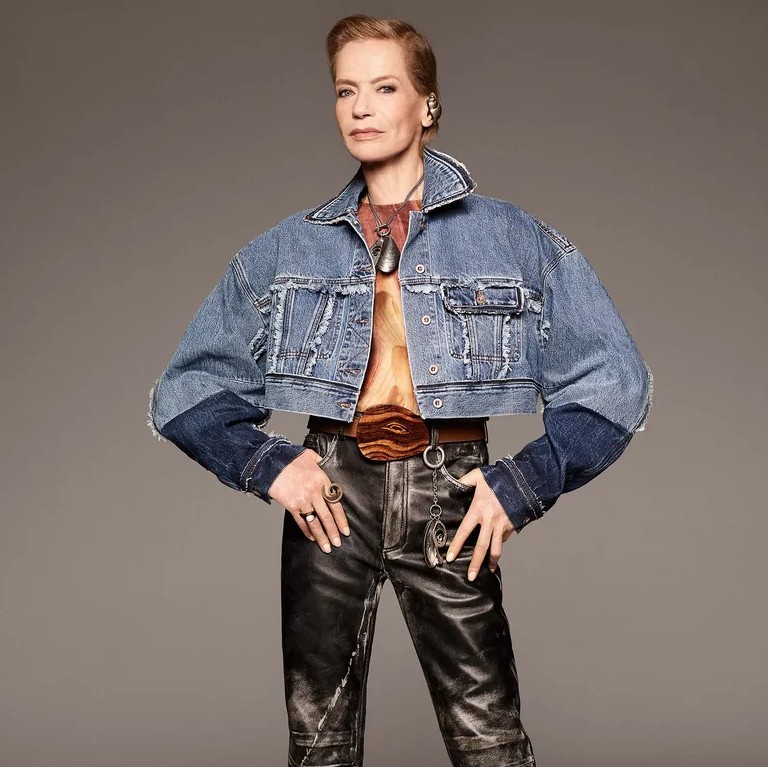
Source: Vogue / Acne Studios
Her Final Years in Berlin
Veruschka spent her later years largely away from the international celebrity spotlight.
After returning to Germany in 2005, she made Berlin her home, maintaining a comparatively private life while her artistic achievements continued to attract attention.
Her last widely documented public appearance took place in September 2017, when she attended the opening of Louis Vuitton’s Time Capsule exhibition in Berlin.
Nevertheless, interest in her work continued throughout the following years.
In 2026, the East Prussian State Museum presented The Seen and the Unseen, an exhibition dedicated to her artistic collaborations with Holger Trülzsch.
The exhibition ran from April 25 through October 18, 2026, illustrating the enduring significance of her experimental work shortly before her death.
On November 24, 2026, Veruschka died at the age of 87.
News of her passing prompted tributes from members of the international fashion community, celebrating not only her achievements as a model but also her contributions as an independent artist.
A Legacy That Transcends Generations
Veruschka belonged to a generation that fundamentally changed the relationship between fashion models and popular culture.
Alongside other pioneering figures of the 1960s, she helped transform modeling into a profession capable of producing internationally recognized personalities.
But her contribution was particularly distinctive.
She demonstrated that fashion photography could become a form of performance, that a model could participate in the creation of an artistic vision, and that beauty did not have to conform to a single definition.
Her life also represented an extraordinary journey through history.
She survived the destruction of her childhood world during World War II, endured the loss of her father, rebuilt her identity in postwar Europe, and eventually became one of the most influential figures in international fashion.
She achieved worldwide recognition, yet remained willing to challenge the very industry that had made her famous.
From the little girl who lost her ancestral home to the woman who graced the covers of Vogue and continued modeling at 78, Veruschka’s life was defined by transformation.
Her passing marks the end of a remarkable chapter in fashion history, but the photographs, performances, and artistic possibilities she helped create will continue to inspire future generations.
Rest in peace, Vera von Lehndorff.
May 14, 1939 – November 24, 2026.
The world may have lost Veruschka, but her extraordinary legacy will remain.