Everyday menswear is full of quiet design fossils—tiny stitched details that most people wear for decades without ever pausing to ask why they exist. Just like the miniature fifth pocket tucked inside blue jeans or the non-functioning buttons lined up along suit cuffs, there is a small, folded fabric strap sewn squarely between the shoulder blades on countless classic button-down shirts.
Resting neatly along the horizontal shoulder seam right above the center fold of the back, this modest loop looks too small for a belt, too subtle for pure decoration, and too specific to be an accident. In truth, that unassuming stitch—known in tailoring circles as the locker loop—carries a surprisingly rich backstory stretching from cramped mid-century naval ships to 1960s American college campuses, where it briefly doubled as an unspoken code for romance.
1. Born Out of Necessity: Cramped Ship Bunks and Zero Closets
Long before the back loop became a hallmark of crisp preppy style, it began as a clever solution to a stubborn storage problem at sea.
During the mid-20th century, East Coast sailors serving aboard naval vessels lived in extraordinarily tight quarters. Sleeping berths offered narrow metal cubbies and wall hooks, with virtually no closet rods or wooden coat hangers in sight. For sailors expected to step onto the deck in neatly pressed uniform shirts, that presented an everyday headache:
- Folding left deep creases: Stuffing a cotton shirt into a cramped seabag guaranteed heavy wrinkles across the chest and sleeves.
- Hanging by the collar ruined the fit: Draping a shirt directly over a metal peg by its neckline quickly stretched the collar out of shape and left a permanent bump at the back of the neck.
Adding a reinforced strip of folded shirting fabric directly beneath the rear shoulder panel (the yoke) solved both issues at once. Because the yoke is built from a double layer of sturdy fabric, anchoring a small hanging loop there allowed a sailor to hook his shirt securely onto a wall peg so gravity could pull the fabric straight without distorting the collar.
2. The 1960s Ivy League Boom: How It Earned the Name “Locker Loop”
While sailors proved the loop’s usefulness, an American shirtmaker turned it into a household icon.
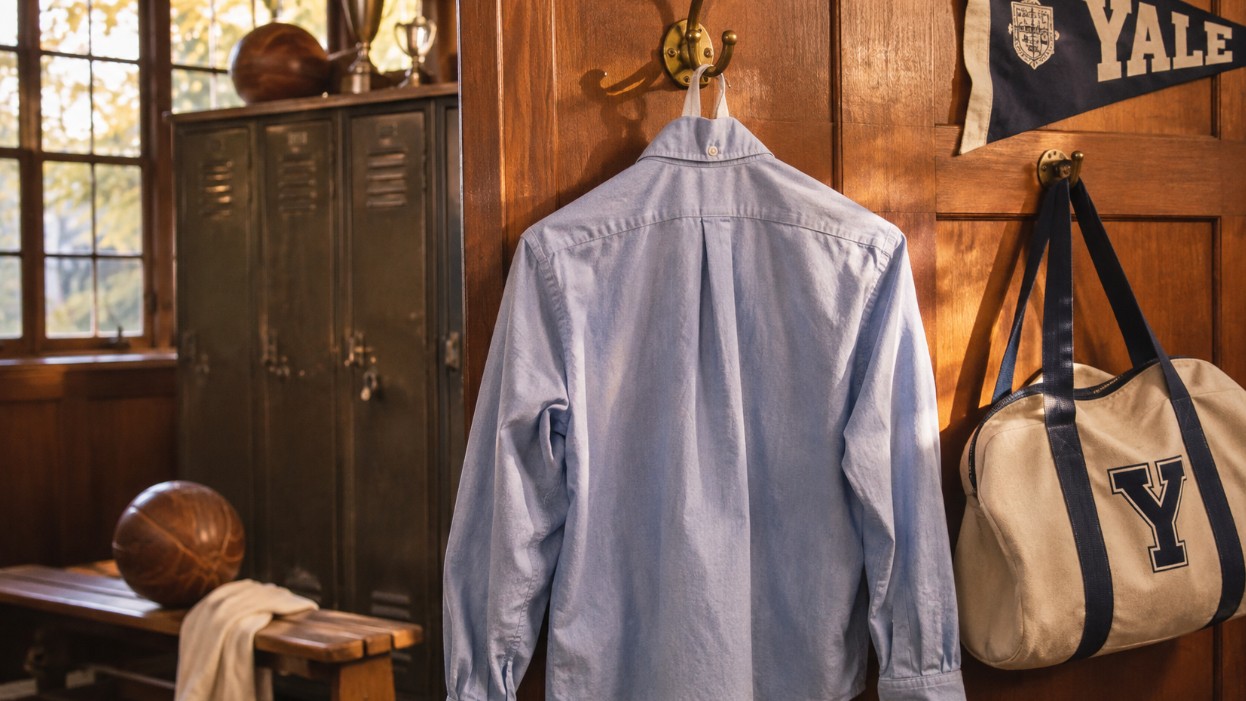
In the early 1960s, Gant—a New Haven, Connecticut shirtmaking company located steps away from Yale University—became famous for perfecting the soft-collared Oxford Cloth Button-Down (OCBD) shirt. Looking for practical touches tailored to active college students, Gant formally introduced the back loop onto its shirts in 1960 and gave it the name that stuck forever: the locker loop.
The appeal on campus was immediate. University athletes heading out for crew practice, squash, or intramural football faced the exact same limitation sailors had encountered years earlier—narrow metal gym lockers lined with wall hooks rather than closet bars. Hanging an Oxford shirt by its locker loop kept the collar crisp and the front placket relatively smooth until class resumed after practice. Within just a few seasons, the feature became an unofficial signature of Ivy League menswear, widely adopted by heritage outfitters across the United States and beyond.
3. The Surprising Twist: An Unspoken Campus Relationship Code
What turned a simple utility stitch into one of fashion’s most memorable legends happened entirely outside the tailoring studio. Once the locker loop appeared on thousands of button-down shirts across 1960s American campuses—from Yale and Harvard to Princeton and beyond—students invented a playful social language around it.
According to enduring campus folklore from the era, the tiny strap on a young man’s back quietly broadcast his relationship status to everyone walking behind him in the quad:
- An Intact Loop Meant “Available”: Leaving the locker loop untouched signaled that a student was single and open to meeting someone.
- Snipping the Loop Meant “Taken”: When a student began going steady with a girlfriend, tradition held that he would cut the locker loop clean off the back of his shirt—or let his girlfriend snip it off herself—as a visible badge that he was officially off the market. In return, she might wear his college scarf or class pin to complete the quiet announcement.
- Playful Hallway Mischief: Because the loop was so easy to spot in crowded lecture halls and corridors, tugging on a classmate’s locker loop became a widespread flirtatious prank. Unfortunately, enthusiastic tugs frequently ripped the yoke seam right off the back of prized Oxford shirts—giving frustrated students a second, purely practical reason to grab a pair of scissors.
Did It Ever Hold a Necktie? One popular modern rumor insists the back loop was originally invented to thread a necktie or cravat before folded collars existed. In reality, menswear historians note that the back loop sits far too low between the shoulder blades to secure a tie. That particular job actually belongs to a completely different detail sitting just two inches higher.

4. The Supporting Cast: Two Classic Details Sitting Right Next to It
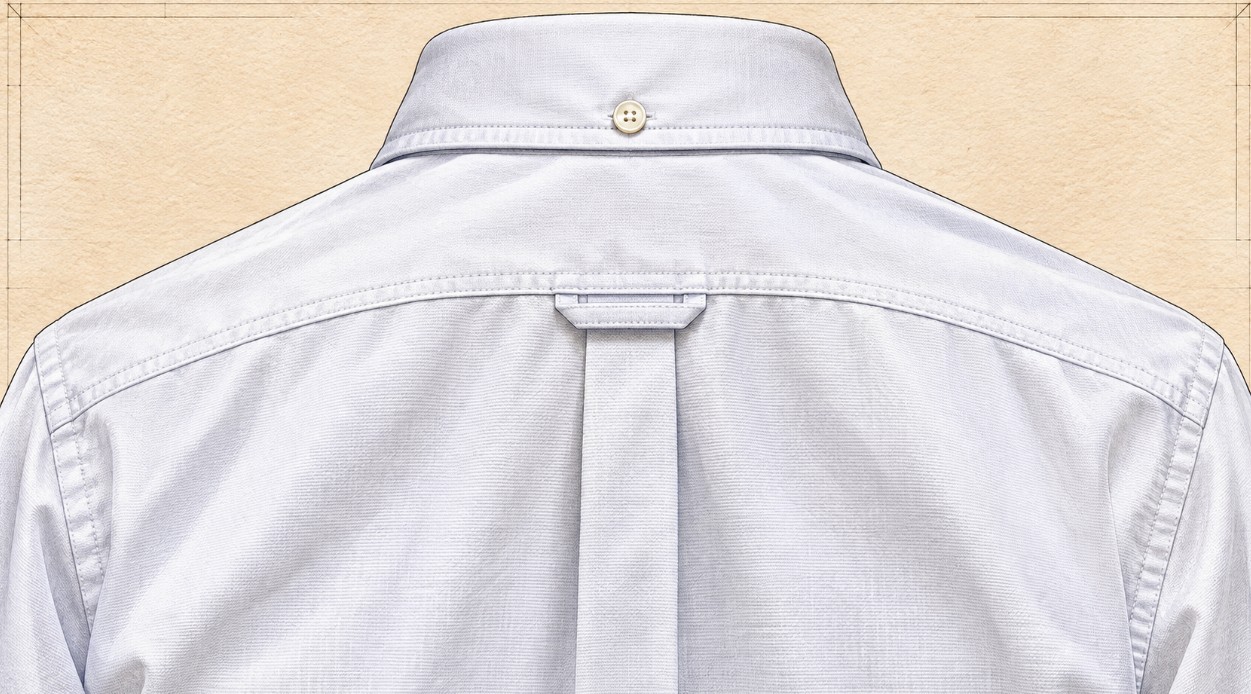
Look closely at the upper back of a traditional button-down shirt, and you will notice the locker loop rarely travels alone. It is usually the centerpiece of a classic three-part rear tailoring system engineered for comfort, neatness, and ease of movement:
| Rear Shirt Feature | Exact Placement | Original Functional Purpose | Role in Modern Menswear |
| Back Collar Button | Centered on the rear band of the collar, directly above the yoke | Keeps a necktie anchored neatly beneath the collar so it cannot ride up at the back of the neck | Signals authentic heritage Ivy styling and prevents soft button-down collars from curling upward |
| Locker Loop | Stitched horizontally into the lower edge of the rear yoke seam | Allows wrinkle-minimizing hanging on hooks inside naval bunks and narrow gym lockers | Serves as a quick temporary hook option and a subtle mark of traditional casual shirting craft |
| Center Box Pleat | A folded vertical column of fabric running downward from beneath the loop | Provides roughly 1 to 1.5 inches (2.5 to 3.8 centimeters) of hidden fabric ease across the upper back | Prevents tight pulling across the shoulder blades when reaching forward, driving, or typing |
Notice how cleanly those three pieces work together visually and structurally: the locker loop sits directly over the top anchor stitch of the center box pleat, reinforcing the exact point where the back panel expands whenever you move your arms.
5. Why Formal Dress Shirts Skip It—And How to Treat It Today
If you check your closet, you may notice a clear pattern: casual Oxford button-downs, chambray shirts, flannels, and polo-collar shirts frequently feature a locker loop, whereas sleek formal dress shirts worn with business suits or tuxedos almost never do.
There is a straightforward tailoring reason for that divide:
- Visual Cleanliness Under Tailoring: Formal poplin or twill dress shirts are designed to drape with razor-sharp flatness across the back, often using twin side pleats near the shoulder blades rather than a center box pleat. A stitched loop creates a slight ridge that feels too casual for formalwear.
- Casual Heritage Identity: On heavier, textured casual weaves like Oxford cloth or brushed chambray, the loop adds tactile character and pays homage to mid-century American sportswear.
Should You Actually Hang Your Shirt by the Locker Loop?
Even though the loop was invented for hanging, garment-care specialists suggest using a little judgment before hooking your favorite shirt on a peg:
- Great for Brief, Temporary Stops: Stepping into a gym shower, changing at a fitting room, or hanging a dry shirt on a bathroom door hook for 15 minutes is exactly what the locker loop still handles effortlessly.
- Avoid Hanging Wet or Heavy Shirts by the Loop: Pulling a damp Oxford shirt straight from the washing machine and suspending its entire water weight from one tiny stitched center point puts heavy tension on the rear yoke—often leaving a stubborn pointed dimple right between the shoulder blades that requires steam ironing to remove.
- Stick to Contoured Hangers for Closet Storage: For overnight and long-term storage, a wide wooden or contoured plastic hanger distributes weight evenly across both shoulders, keeping the collar, yoke, and sleeves crisp for years.
A Small Stitch With Staying Power
Few details in modern clothing bridge pure utility and cultural nostalgia quite as effortlessly as the locker loop. Born to keep sailors’ shirts tidy in cramped ship cabins, popularized for 1960s collegiate gym lockers, and immortalized in campus dating rituals, that tiny strip of folded cotton long ago outlived the problem it was invented to solve. Today, it remains a quiet nod to thoughtful craftsmanship—a reminder that even the smallest stitch on an everyday shirt often holds a story worth knowing.