Turn almost any classic Oxford button-down, flannel, or chambray shirt around, and you will spot a modest ribbon of stitched fabric sitting right below the upper shoulder seam and directly above the center pleat. Most people spend decades buttoning up their shirts without giving that tiny strap a second thought—assuming it is nothing more than a convenient little hook for hanging a shirt on a bathroom peg or a quirky bit of leftover decoration.
In truth, that unassuming inch of cloth carries one of the richest backstories in modern menswear. Known officially as the locker loop, this detail traveled a remarkably colorful path—from cramped naval quarters to mid-century university gymnasiums, where it unexpectedly transformed into a silent 1960s dating code that left countless prized shirts ripped right down the back. Understanding how it was born, what it once signaled about a wearer’s love life, and how it shapes modern dress-shirt etiquette turns an everyday wardrobe detail into a fascinating piece of wearable history.
Born in Tight Quarters: From Naval Ships to Ivy League Lockers
Like many enduring features of classic menswear—from trench coats to button-down collars—the locker loop began as a purely practical solution to a cramped, real-world problem.
The Maritime Forerunner
Long before it appeared on crisp campus shirts, utilitarian fabric loops were stitched onto the collars and upper backs of heavy workwear and United States Navy garments on the East Coast. Life aboard a naval vessel offered almost zero personal storage space; sailors shared tight sleeping bays outfitted with narrow metal hooks rather than spacious closets or wooden coat hangers. A sturdy fabric loop let a sailor hang a shirt or jacket securely on a cabin peg so it would stay off damp decks and remain relatively crease-free while the ship rolled at sea.
The 1950s New Haven Breakthrough
The feature made its historic leap from utilitarian gear to iconic everyday style in the mid-1950s, courtesy of Gant, a shirtmaking company founded in 1949 by the Gantmacher family in New Haven, Connecticut—just blocks from Yale University.
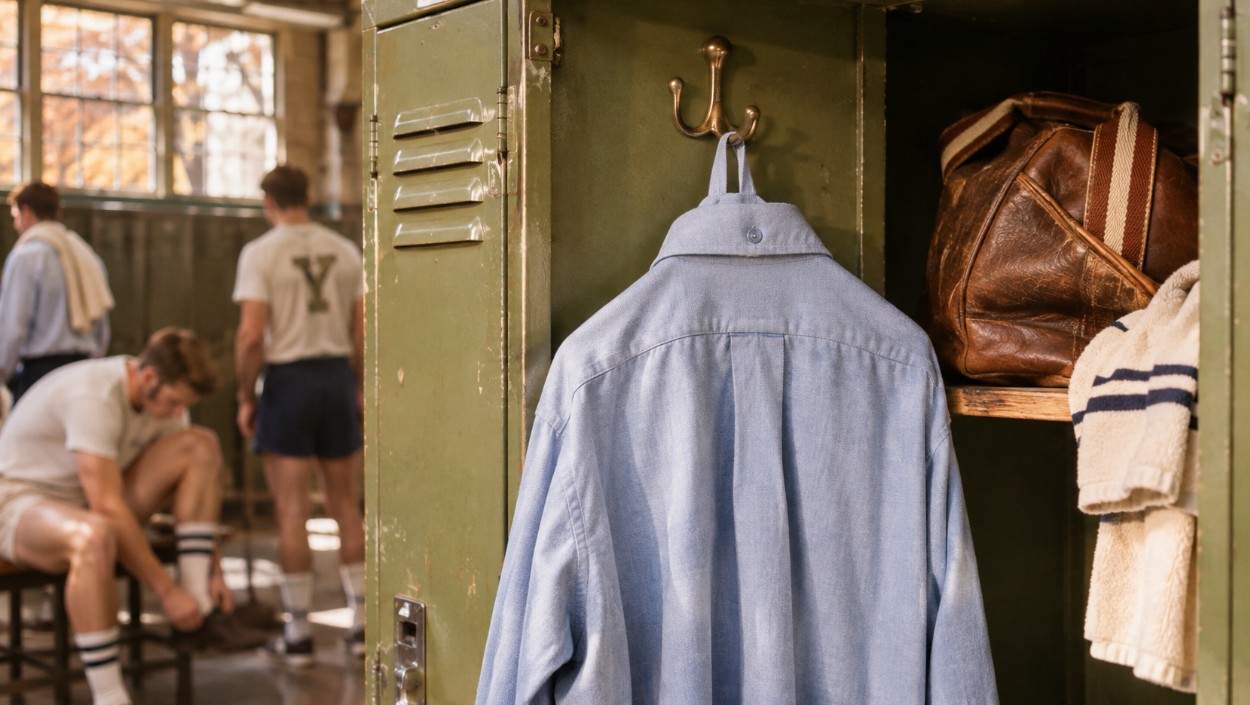
At the time, the company was perfecting the soft-rolled Oxford cloth button-down (OCBD) shirt for students shopping at the famed Yale Co-op. Collegiate life in the 1950s and early 1960s had a very specific wardrobe rhythm: young men wore collared shirts and jackets to morning lectures, then rushed straight into crowded university gymnasiums for rowing, squash, or athletics. Metal gym lockers were notoriously narrow and rarely held coat hangers.
To solve the problem of students stuffing their prized Oxford shirts into crumpled heaps at the bottom of sweaty lockers, Gant stitched a reinforced fabric loop directly onto the outer back yoke seam—officially coining the term locker loop. Students could slip the loop over a standard metal locker hook, keep their collar crisp during practice, and pull on a tidy shirt afterward without needing an iron. Within a few years, rival American shirtmakers adopted the feature nationwide, cementing it as a signature emblem of the golden era of Ivy League style.
Before Relationship Statuses Existed: The Unspoken 1960s Dating Code
If the locker loop had remained merely a clever piece of gym-room hardware, it would be a neat footnote in clothing design. What elevated it into pop-culture legend was what American college students did with it during the 1960s.
Decades before smartphones, dating profiles, or online relationship statuses, campus communities relied on subtle, wearable signals to broadcast romance—letterman sweaters, fraternity pins, class rings, and, surprisingly, the back of a man’s button-down shirt. Across East Coast universities and soon high schools throughout the United States, the locker loop evolved into an unmistakable romantic shorthand:
- Loop Intact — Single and Available: Walking across campus with your locker loop untouched signaled that you were unattached. In a playful (and occasionally chaotic) flirting ritual, a bold admirer who had a crush on a classmate might sneak up behind him and tug—or outright rip—the loop off his shirt to express interest. Because Oxford cloth is tightly woven and the loop was sewn directly into the yoke seam, an enthusiastic yank frequently tore a jagged hole straight through an expensive shirt.
- Loop Snipped Off — Officially “Going Steady”: When a male student entered a committed relationship, he would take a pair of scissors and neatly cut the locker loop off his shirts. A missing loop broadcast clearly to everyone in the lecture hall that he was taken. In return, his girlfriend would often wear his university scarf or jacket around campus to complete the matched signal.
- The Teasing Campus Nicknames: As the ritual spread from Ivy League quads to high school hallways across the country, the loop picked up several mischievous nicknames—most famously “fruit loop” and “fairy loop”—as students teased each other or tried to snap loops off friends’ backs as a prank between classes. By the late 1960s, some frustrated parents and shirtmakers even wondered aloud in newspaper style columns whether the loop would survive all the ripped shirts it inspired.
Reading the Architecture of a Classic Shirt Back
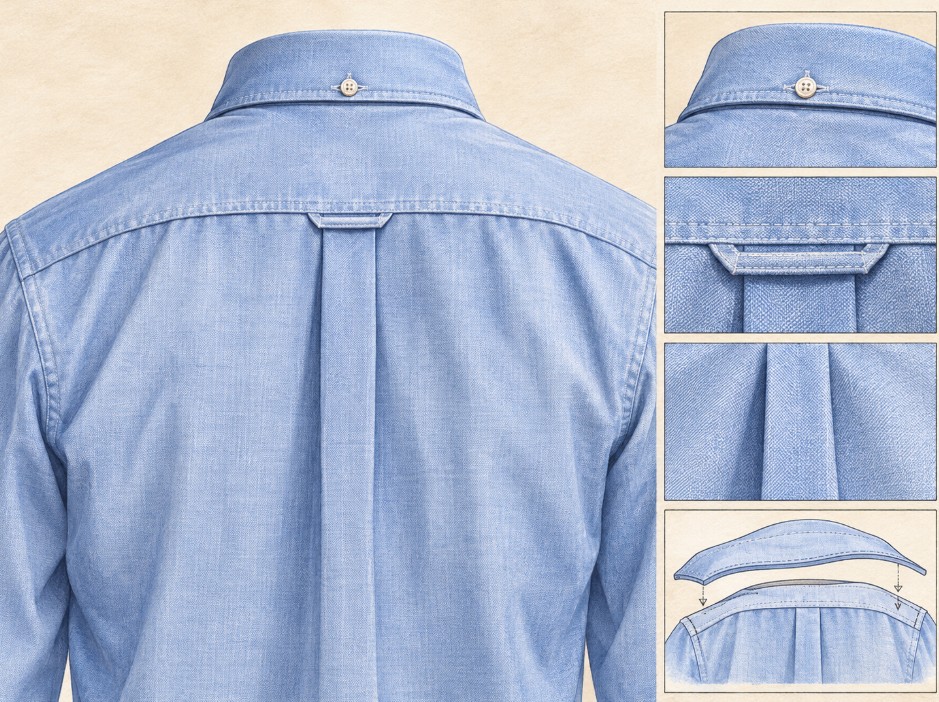
Look closely at the upper back of a traditional casual button-down, and you will notice that the locker loop does not float on its own. It sits at the exact architectural intersection of three coordinated tailoring elements—each with its own job:
- The Back Yoke: The horizontal panel of double-layered fabric spanning from shoulder to shoulder across the upper back. The yoke bears the structural weight of the entire shirt, draping smoothly over the curve of the shoulder blades and reinforcing the seams against daily movement.
- The Center Box Pleat: Directly beneath the locker loop, the fabric folds inward on both sides to create a clean vertical channel called a box pleat. This hidden fold of extra cloth expands smoothly whenever you reach forward to drive, write at a desk, or pick up groceries—giving athletic shoulders room to move without straining the front buttons.
- The Locker Loop’s Anchor Role: Stitching the locker loop directly into the horizontal seam right above the box pleat was no accident. That double-thick yoke seam is the strongest load-bearing junction on the back of the shirt, allowing the loop to hold the garment’s weight without ripping away from thinner single-layer fabric.
- The Vanished Sibling — The Back Collar Button: Alongside the locker loop and box pleat, mid-century Ivy shirts featured a third back detail: a tiny third collar button positioned dead-center at the nape of the neck. Its purpose was to anchor a necktie neatly under the collar roll so it would never ride up over the back of the neckband. Today, you will still find that tiny rear button on faithful heritage reissues.
The Subtle Formality Rule: Where the Locker Loop Belongs Today
Even though few people snip off shirt loops to announce an anniversary anymore, the tiny strap still communicates an important unspoken message in modern menswear: level of formality.
Tailors and stylists use the presence—or absence—of a locker loop to tell a sport shirt apart from a formal dress shirt at a single glance:
| Shirt Detail | Casual & Heritage Sport Shirts | Formal Business & Dress Shirts |
| Locker Loop | Frequently present along the center yoke seam | Always omitted for a sleek, uninterrupted silhouette |
| Back Pleat Style | Center box pleat (relaxed, athletic movement) | Smooth darted back or subtle side pleats near the shoulders |
| Typical Fabrics | Heavy Oxford cloth, flannel, chambray, denim, brushed twill | Fine poplin, crisp broadcloth, pinpoint twill, tuxedo piqué |
| Best Pairing | Chinos, jeans, tweed blazers, knit sweaters, casual Fridays | Tailored wool suits, formal weddings, black-tie events |
Because a locker loop adds a tiny bump of texture along the upper spine, wearing a looped shirt underneath a razor-sharp, unlined formal suit jacket can feel slightly casual. Conversely, spotting a neatly stitched loop on a textured blue Oxford or soft weekend flannel is a quiet badge of authentic American heritage craftsmanship.
Practical Verdict: Should You Actually Hang Your Shirt by the Loop?
Knowing the history naturally raises one very practical everyday question: if the loop was built for hanging shirts, should you actually use it?
The short answer from garment-care specialists is yes for brief stops, no for long-term storage.
- When It Works Well: If you are changing at the gym, stepping into a fitting room, steaming out light travel wrinkles in a hotel bathroom, or slipping your shirt off while painting or cooking, hanging a sturdy Oxford or flannel shirt on a blunt hook for an hour or two does exactly what it was engineered to do.
- Why Closet Hangers Still Win Overnight: Hanging a damp or freshly laundered shirt from a single central point overnight allows gravity to pull the entire weight of the wet cotton down from one inch of seam. By morning, you will often find a stubborn pointed dimple right between the shoulder blades and stretched collar lines. For everyday closet storage, a wide, contoured wooden hanger supports the natural slope of the shoulders and keeps the yoke flat.
- Ironing Tip for a Crisp Back: When pressing a shirt with a locker loop, never plow a hot iron blindly straight over the strap—doing so can leave a shiny pressure imprint on the cotton or fold the loop permanently sideways. Instead, lay the shirt flat, smooth the loop gently upward toward the yoke with your fingertips, press neatly around the box pleat below it, and finish with a light burst of steam across the yoke seam.

The Enduring Charm of Everyday Design Clues
The locker loop joins a beloved club of vestigial clothing details—features that outlived their original daily urgency yet survived because they connect modern wardrobes to living history. Just like the tiny fifth pocket on blue jeans (originally stitched for 19th-century pocket watches), the row of buttons on suit jacket cuffs, or the crossed V-stitch beneath a sweatshirt neckline, that small strap between your shoulder blades is a quiet monument to human ingenuity and social culture.
The next time you pull a classic button-down off its hanger and notice that modest loop resting neatly above the pleat, you are looking at far more than a spare strip of thread—you are seeing a clever relic of naval cabins, 1950s gym lockers, and a wonderfully nostalgic era when a single snip of the scissors told the whole campus you had found someone special.