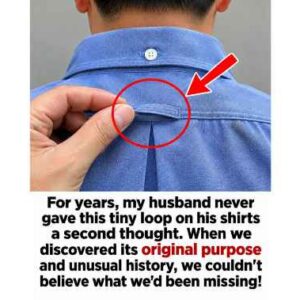
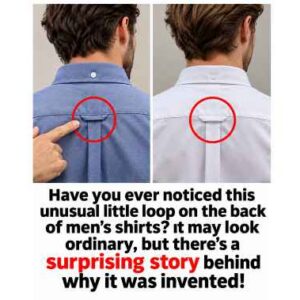
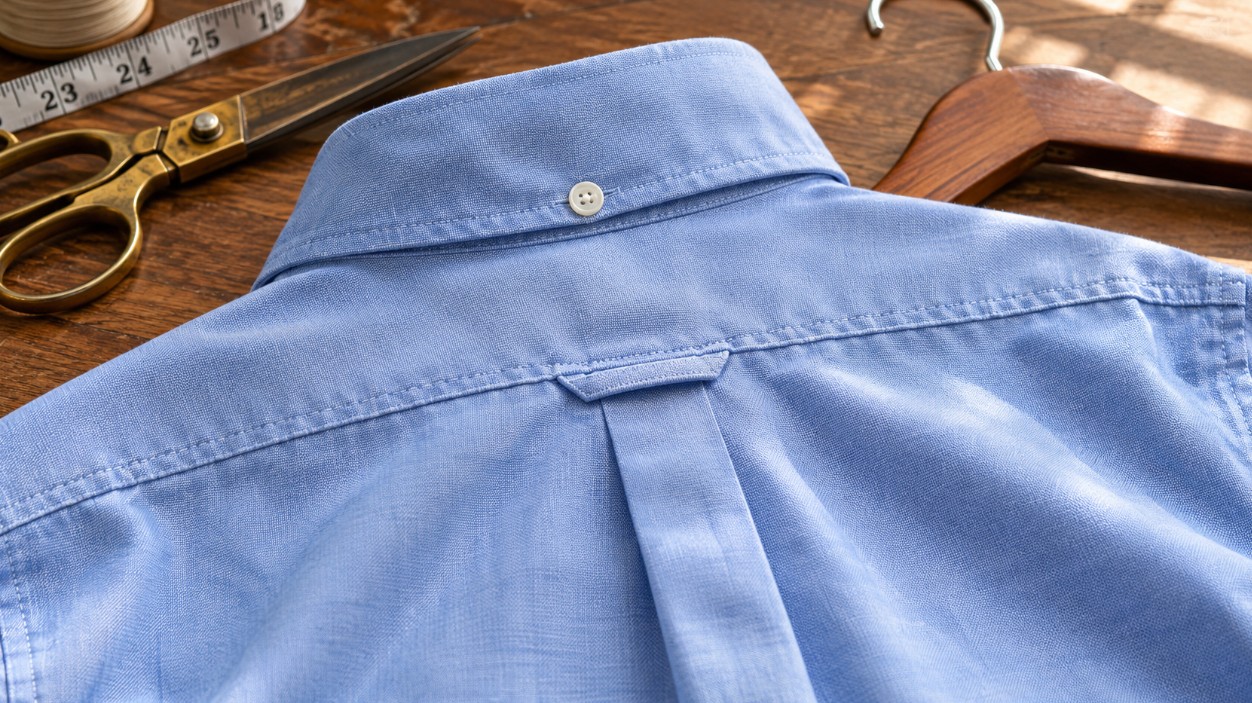
Stitched quietly along the upper back of millions of button-down shirts—tucked right beneath the horizontal shoulder yoke and centered above the vertical back pleat—sits a modest strip of folded cloth barely an inch wide. Most men slip their shirts on every morning without ever feeling it against their shoulders, yet anyone standing behind them in an elevator, at a coffee counter, or while folding laundry eventually stops and asks the same puzzling question: What is that tiny loop actually for?
Over the decades, this unassuming strip of cotton has sparked countless household debates. Some insist it is a clever hidden guide meant to hold a necktie in place. Others argue it is purely decorative stitching left behind by traditional tailors, or a fragile little handle meant for coat hooks.
As it turns out, the real history of this tiny loop is far richer—and far more surprising—than a simple garment-factory quirk. Officially known in menswear as a locker loop, its journey traces a remarkable path from cramped wartime ships to Ivy League gymnasiums, eventually evolving into a secret 1960s campus dating signal before becoming one of fashion’s most enduring heritage details.
Chapter 1: Born at Sea — Solving a Sailor’s Wardrobe Problem
Long before the tiny back loop appeared on crisp office shirts or weekend chambray button-downs, it was born out of sheer nautical practicality.
In the mid-20th century, East Coast merchant mariners and U.S. Navy sailors lived aboard vessels where every cubic inch of personal space was fiercely rationed. Shipboard berths did not come equipped with spacious walk-in closets or rows of wooden hangers; instead, sailors stowed their belongings inside narrow metal wall lockers fitted with simple brass hooks.
Tossing a freshly pressed uniform shirt into a cramped duffle bag or cramming it onto a tiny shelf left it hopelessly rumpled. Shirtmakers solved the problem by sewing a sturdy little loop of matching fabric right at the center of the upper back yoke. By slipping that loop onto a locker hook, a sailor could hang his shirt neatly flat against the bulkhead—keeping the collar sharp, the sleeves uncreased, and the fabric off damp cabin floors even in rough ocean swells.

Chapter 2: The 1960 Ivy League Boom
The locker loop might have remained an obscure military footnote had it not been for a pivotal fashion moment in New Haven, Connecticut.
In 1960, Gant Shirtmakers—a family-run company located just blocks from Yale University—officially introduced the locker loop onto its signature Oxford Cloth Button-Down (OCBD) shirts. At the time, collegiate menswear was booming, and Ivy League campuses set the style standard for young men across America.
The timing was brilliant. Just like sailors aboard cramped naval vessels, college athletes and students spent hours in shared university gymnasiums and rowing clubhouses where narrow metal gym lockers had wall hooks instead of closet rods. Before the locker loop arrived, a student heading to basketball practice or squash had to wad his crisp Oxford shirt into the bottom of a locker beside sweaty sneakers. With the new back loop stitched seamlessly into the yoke, students could hang their dress shirts neatly on a hook while they worked out, then slip them right back on wrinkle-free before walking to their next lecture.
Within a few years, the practical detail became so universally loved that rival heritage makers—including Brooks Brothers and other collegiate outfitters—embraced the silhouette, cementing the “locker loop” into the permanent vocabulary of classic American menswear.
Chapter 3: The Surprising Campus Twist — A Secret Signal of Romance
What began as a humble laundry-saving hack soon took an unexpected cultural turn that still catches modern readers completely off guard. During the height of 1960s American college culture, the locker loop quietly transformed into an unspoken social code—a way for students to broadcast their relationship status without saying a single word.
Across Ivy League quads and university campuses nationwide, a playful romantic ritual emerged:
- Intact Loop = Single and Available: Walking across campus with the locker loop cleanly intact signaled that a young man was unattached. Playful admirers occasionally teased crushes by tugging gently on the back loop in crowded hallways—a campus tradition so common that it even earned lighthearted nicknames among students.
- Snipped Loop = Officially “Going Steady”: The moment a male student entered a committed relationship, his girlfriend—or the student himself—would deliberately snip or rip the locker loop straight off the back of his shirts. Showing up to class with a missing loop (and a couple of telltale loose threads beneath the yoke) announced to everyone walking behind him that he was officially off the market.
- Wearing a Token of Affection: In a variation of the trend, some couples went even further, tying a colored ribbon or a matching piece of scarf fabric through the loop to show off their steady partner.
Of course, the loop also attracted its fair share of schoolyard mischief. Friends and rivals routinely grabbed the loop from behind to yank someone backward in the corridor—sometimes ripping a small triangular tear right through the upper back fabric. By the late 1960s and 1970s, a few manufacturers briefly paused sewing loops onto casual shirts to prevent torn fabric and prank wars, though classic Oxford shirtmakers ultimately brought the cherished feature back as a badge of authenticity.

Chapter 4: Settling the Household Debate — The Loop vs. Its Two Neighbors
Part of the reason people disagree so strongly about what the back loop is meant to do is that classic men’s button-down shirts actually pack three separate heritage design features within a few inches of each other on the upper back. Each one solves a completely different tailoring problem—and people routinely mix up their jobs.
| Shirt Feature | Where to Find It | What People Often Guess | Its True Original Purpose |
| The Locker Loop | Sewn horizontally just beneath the back shoulder yoke seam | A holder to thread a necktie through | Hanging a shirt neatly on a hook in ship cabins and gym lockers without a hanger |
| The Back Collar Button | A tiny third button centered on the rear outside of the collar | A spare replacement button sewn on for convenience | Anchoring a necktie cleanly beneath the collar so it never slips upward in the back |
| The Center Box Pleat | The vertical folded pleat running directly down from the loop | Pure decorative styling to add visual texture | Providing extra folded fabric across the shoulder blades so arms move freely without pulling |
Look closely at the top of a classic button-down shirt and the confusion makes instant sense: the famous “necktie trick” really does exist—it just belongs to the tiny button on the back of the collar, not the fabric loop two inches below it. Together, the rear collar button, locker loop, and center box pleat form the iconic “Ivy League trinity” of traditional shirtmaking.
Chapter 5: Does the Locker Loop Still Have a Job Today?
In an era of spacious home closets and padded wooden hangers, the locker loop survives primarily as a nod to heritage craftsmanship—a subtle visual cue that a shirt was patterned after classic mid-century tailoring. Still, that tiny inch of cotton remains genuinely handy in everyday modern life, provided you know how to use it without damaging your shirt.
When Using the Loop Makes Sense:
- Quick Gym or Pool Stops: Hanging a shirt inside a narrow locker stall while you shower keeps it clean and off damp benches.
- Hotel Rooms and Travel: When you step into a steamy hotel bathroom to freshen up a wrinkled button-down and every closet hanger is already taken, slipping the locker loop over a door hook lets rising steam relax creases smoothly.
- Handheld Garment Steaming: Catching the loop on a wall peg gives you an effortless anchor point to run a steamer quickly down the front plackets and sleeves.
Two Clothing Care Mistakes to Avoid:
- Never Hang a Soaking-Wet Shirt by the Loop: Wet cotton or heavy flannel weighs several times more than dry fabric. Suspending a wet shirt from a single one-inch stitch point pulls heavily on the yoke seam, distorting the shoulders and creating a stubborn pucker right between the shoulder blades.
- Skip Long-Term Closet Storage on Hooks: For overnight or multi-week storage, a properly shaped hanger supports the full width of the shoulder yoke evenly. Treat the locker loop as a convenient short-term pit stop—just as sailors and college athletes originally intended.
A Small Stitch With a Big Story
The next time someone spots that tiny folded loop resting below the collar of a button-down shirt and wonders why tailors still bother sewing it on, the answer settles the argument with a story few people ever expect.
What looks like an accidental extra scrap of cloth is actually a surviving piece of living history—engineered to keep sailors sharp at sea, adopted by 1960s college athletes in locker rooms, snipped away as a quiet badge of young love on Ivy League quads, and preserved today as a timeless hallmark of thoughtful design. Sometimes, the smallest details stitched into our everyday clothes turn out to carry the best stories of all.